



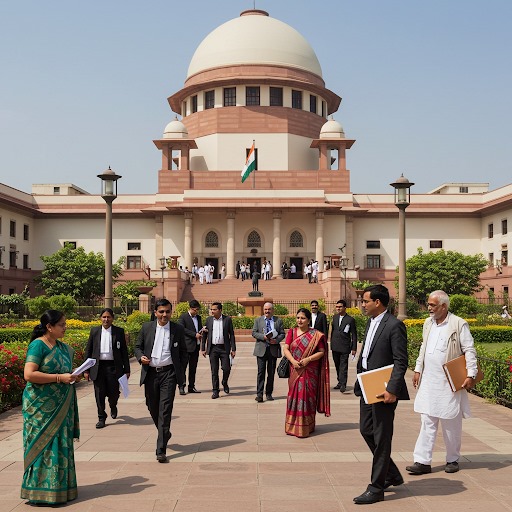
DATE: 09/01/2019
BENCH: Chief Justice Uday Umesh Lalit, Justice Dinesh Maheshwari, Justice Bela M Trivedi, Justice J B Pardiwala, and Justice Shripathi Ravindra Bhat
FACTS:
In response to the prevailing socioeconomic conditions, the Indian government enacted the 103rd Constitutional Amendment Act, 2019, introducing a 10% reservation for economically weaker sections (EWS) of society. It is essential to recognize that the Indian Constitution permits reservations solely based on socioeconomic and educational deprivation. This amendment added two new provisions—Article 15(6) under Article 15 and Article 16(6) under Article 16—explicitly providing for EWS reservations in both government jobs and educational institutions, including both aided and unaided private institutions. However, minority institutions were exempted from this reservation policy under Article 30(1) of the Constitution, which safeguards their rights. One of the key aspects of this amendment was that it did not alter the existing seat distribution in government jobs and educational institutions but instead expanded the total number of available seats. For instance, in an institution with 100 seats, an additional 10 seats were created to accommodate EWS candidates, increasing the total number of seats to 110. This policy led to significant constitutional and legal debates regarding the state's authority to introduce new criteria for reservation based on economic status. As a result, the Supreme Court was approached with approximately twenty petitions challenging the validity of the amendment, leading to an extensive judicial review on whether the amendment violated the basic structure of the Constitution.
ISSUES:
The issues raised key legal questions about reservations based solely on economic criteria. A major issue was whether economic status alone could justify reservation, as the Constitution traditionally considers socioeconomic and educational deprivation. Another concern was whether SCs, STs, and SEBCs should be excluded from the EWS quota, given that they already benefit from caste-based reservations. Additionally, the amendment challenged the 50% reservation cap set in Indra Sawhney (1992) and raised concerns about the state's power to mandate reservations in private aided and unaided institutions. These issues led to multiple Supreme Court petitions questioning the amendment's constitutional validity.
JUDGEMENT WITH REASONING:
The Supreme Court upheld the 103rd Constitutional Amendment Act, 2019, ruling that reservations based solely on economic criteria are constitutional. The majority held that the EWS quota does not violate the basic structure of the Constitution and that the exclusion of SCs, STs, and OBCs from the EWS category is valid, as they already benefit from caste-based reservations. The Court also determined that exceeding the 50% reservation cap set in Indra Sawhney (1992) was permissible in extraordinary circumstances, as this amendment created additional seats rather than altering existing quotas. Furthermore, the Court found that applying EWS reservations to private institutions was reasonable, ensuring equal access to education. However, the judgment was split, with dissenting opinions arguing that the amendment violated the principle of equality by excluding socially and educationally backward groups from the EWS quota.
The Supreme Court upheld the 103rd Constitutional Amendment Act, 2019, primarily on the grounds that economic backwardness is a valid criterion for reservation under Articles 15 and 16. The majority held that the Constitution does not prohibit reservations based on economic criteria, and the state has the authority to introduce new classifications to promote social justice and equality. The Court reasoned that the exclusion of SCs, STs, and OBCs from the EWS quota was justified since these groups already benefit from existing caste-based reservations. The Court emphasized that the amendment does not take away any rights from socially and educationally backward classes but instead creates an additional category for economically weaker sections. Moreover, it stated that the 50% reservation cap set in Indra Sawhney (1992) was not an absolute rule and could be exceeded under extraordinary circumstances, as in this case, where additional seats were created instead of altering the existing quota system.
Another key justification was the inclusion of private institutions within the scope of EWS reservations. The Court reasoned that ensuring equal access to education in both government-funded and private institutions was in line with the directive principles of state policy. It emphasized that the state has the power to enforce affirmative action policies in private educational institutions to expand opportunities for economically disadvantaged groups. However, the decision was not unanimous, as the dissenting judges argued that excluding SCs, STs, and OBCs from the EWS category violated the constitutional principle of equality by restricting economic-based reservations only to the "unreserved" category. They also expressed concerns that exceeding the 50% cap on reservations could distort the balance of merit and equality in public employment and education.
ANALYSIS:
The Supreme Court’s decision to uphold the 103rd Constitutional Amendment Act, 2019, marked a shift in India’s reservation policy by recognizing economic disadvantage as a valid criterion for affirmative action. The majority ruled that economic-based reservations do not violate the basic structure of the Constitution and that excluding SCs, STs, and OBCs from the EWS quota was justified since they already benefit from caste-based reservations. The Court also held that exceeding the 50% cap set in Indra Sawhney (1992) was permissible as the amendment expanded seats rather than altering existing quotas. Additionally, the inclusion of private institutions was seen as essential to ensuring equal access to education. However, dissenting judges argued that excluding socially and educationally backward groups from EWS reservations violated Article 14, as economic deprivation exists across all communities. They also warned that exceeding the 50% reservation cap could undermine merit-based opportunities and set a problematic precedent. Some justices viewed the extension of EWS reservations to private institutions as an overreach of state power. Despite these concerns, the majority upheld the amendment, emphasizing that the state has broad authority to design affirmative action policies based on evolving socioeconomic needs.
 info@adhwaitha.com