



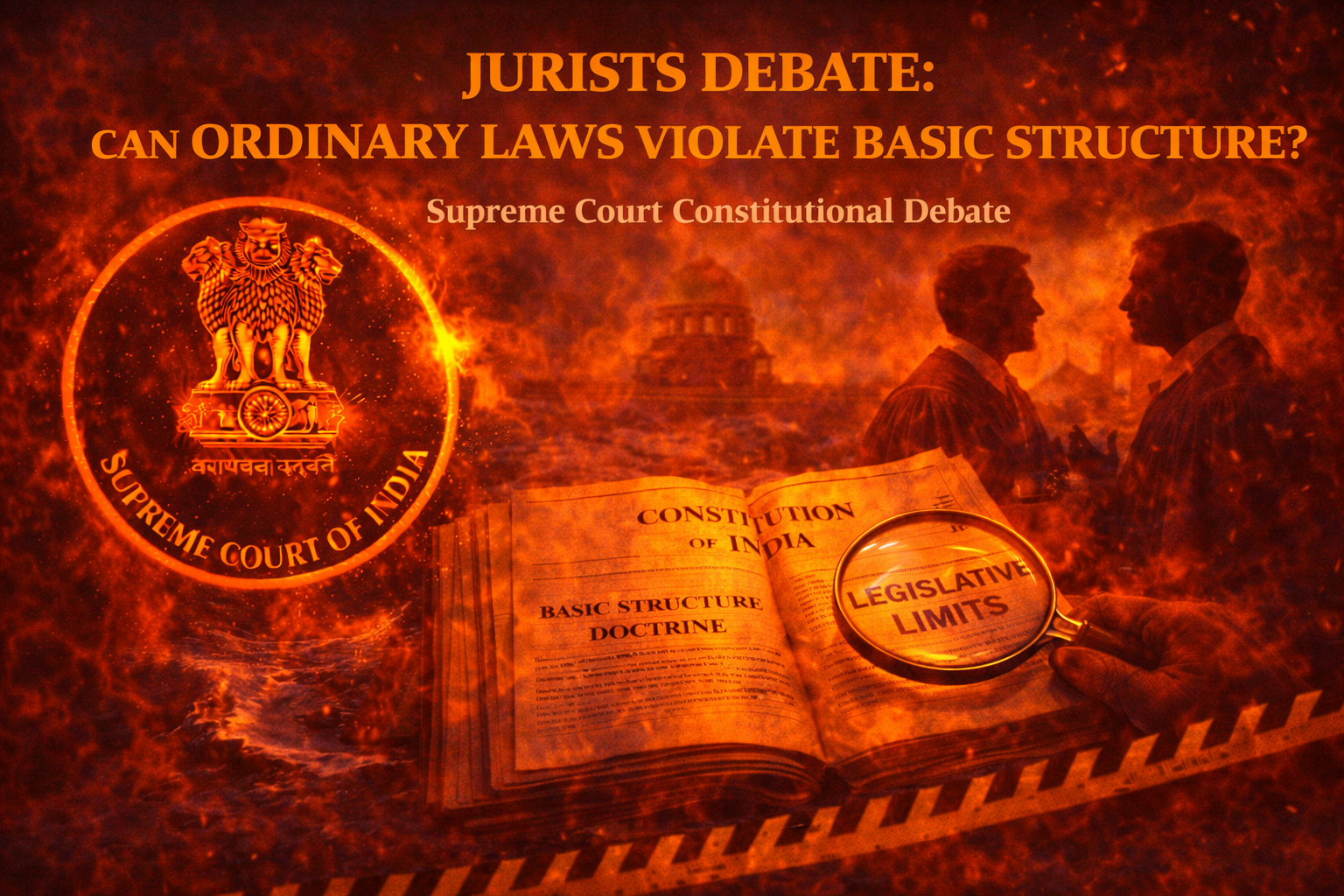
During a panel discussion at the launch of former Supreme Court judge Justice Rohinton Fali Nariman's new book on the Basic Structure Doctrine, Senior Advocates Kapil Sibal, Dr. Abhishek Manu Singhvi, and Arvind Datar expressed concerns about the potential for ordinary legislation to undermine the basic structure of the Constitution.
While the Supreme Court has consistently held that constitutional amendments can be invalidated if they violate the basic structure, the panellists highlighted that laws passed by Parliament in its ordinary legislative capacity are not subjected to the same scrutiny. Referring to the recent Supreme Court ruling in Anjum Kadari vs Union of India, they noted that the Court reaffirmed its stance that an ordinary law cannot be struck down solely for violating the basic structure unless it infringes upon a specific fundamental right. Kapil Sibal pointed out the inconsistency, stating that the same law—if enacted as a constitutional amendment—could be invalidated for violating the basic structure, yet would stand if passed as an ordinary statute.
“If you had the same law passed through a constitutional amendment, it will be struck down as it will be violating our basic structure, but the ordinary legislation which is contrary to basic structure is upheld by court”, he said.
Kapil Sibal emphasized that the basic structure doctrine is firmly entrenched and irreversible. Citing Article 359 of the Constitution, he pointed out that even during a national emergency, the rights guaranteed under Articles 20 and 21 remain in force. According to Sibal, this reflects the Constitution’s inherent limitations on the exercise of power, and the basic structure doctrine naturally arises from this foundational principle.
Kapil Sibal raised concerns about the growing threat to the Constitution’s basic structure through ordinary laws. He argued that while constitutional amendments can be struck down for violating the basic structure, no such safeguard exists for regular legislation—even if it undermines core constitutional values. Sibal pointed out a legal gap: such laws can't be challenged on basic structure grounds unless they also violate specific fundamental rights, which courts are often hesitant to enforce. He warned that this loophole is enabling routine violations, particularly affecting federalism and secularism. As an example, he noted that while a constitutional amendment favoring one community could be struck down, a regular law allowing the demolition of their monuments might stand. “There’s a real problem our country will face in time,” he warned.
Senior Advocate Dr. Abhishek Manu Singhvi emphasized that the basic structure doctrine reflects the principle that "power corrupts and absolute power corrupts absolutely." He argued that constitutions are designed to protect against majoritarianism, with the basic structure ensuring that all exercises of power stay within constitutional boundaries.
Dr. Abhishek Manu Singhvi emphasized that the issue of whether ordinary laws can be tested against the basic structure should be revisited by a larger bench. He pointed out that Justice Mathew's remarks in Indira Gandhi v. Raj Narain have been interpreted to suggest that only constitutional amendments can be challenged on the grounds of the basic structure, a view that has been followed in later judgments based on a misreading of Mathew's comments. Singhvi argued that this has led to a situation where laws that could undermine the basic structure remain unchallengeable unless they are unconstitutional, and stressed the need for a constitution bench to address this critical legal issue.
Senior Advocate Arvind Datar highlighted the paradox that while constitutional amendments can be struck down for violating the basic structure, ordinary laws cannot. He referenced Justice Beg's opinion in State of Karnataka v. Union of India, which acknowledged the possibility of challenging ordinary laws on basic structure grounds. Datar criticized Justice Mathew's observation as an obiter dictum, questioning why such a restriction exists. Justice Nariman further clarified that the basic structure is not a separate concept but is embedded in the Constitution's actual wording. He argued that any ordinary law offending an Article of the Constitution, whether related to the basic structure or not, can be struck down for violating the Constitution.
 info@adhwaitha.com