Supreme Court: Capital Punishment Is an Exception, Even for Multiple Murders, If Reform Is Possible

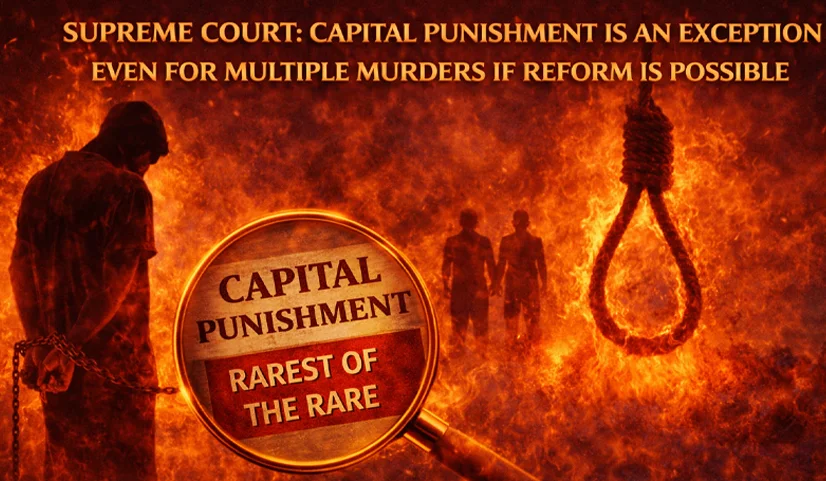



Recently, the Supreme Court upheld the conviction of a man for murdering his wife and four minor daughters but reduced his death sentence to life imprisonment without the possibility of remission. The Court took into account factors such as the absence of a criminal history, positive prison reports suggesting potential for reform, and existing precedents that discourage the imposition of the death penalty in cases involving multiple murders.
The Court emphasized that even in cases involving multiple murders, the death sentence should not be imposed if the convict demonstrates potential for reform. This potential for reform must be supported by mitigating factors such as the convict's age, absence of a prior criminal record, socioeconomic background, and other relevant circumstances that could suggest the possibility of rehabilitation. The Court highlighted that the focus should be on the individual’s capacity to change, and that factors beyond the gravity of the crime itself should be considered when determining the appropriate punishment.
“This Court has consistently recognized that the imposition of capital punishment is an exception and not the rule. Even where multiple murders have been committed, if there is evidence or at least a reasonable possibility of reform, a lesser sentence must be preferred”, the court observed.
A bench consisting of Justices Vikram Nath, Sanjay Karol, and Sandeep Mehta heard the case in which the appellant had been convicted of the brutal murders of his wife and four minor daughters. The conviction was based on circumstantial evidence, and the trial court sentenced him to death. This verdict was subsequently upheld by the High Court, which affirmed the gravity of the crime and the need for capital punishment. However, the case later reached the Supreme Court for further review.
The appellant challenged the imposition of the death penalty, arguing that the crime did not meet the criteria for being classified as a "rarest of rare" case that would justify such a severe punishment.
The Court deliberated on whether the brutal murder of the appellant's entire family could be categorized as a "rarest of rare" case that would merit the death sentence. In its ruling, the Court disagreed, asserting that the case did not meet the stringent standards set by the "rarest of rare" doctrine, which was established in the landmark Bachan Singh v. State of Punjab case in 1980. According to Bachan Singh, the death penalty should only be imposed in exceptional cases where the crime is of an extraordinarily heinous nature, such as when:
a. The crime is exceptionally brutal, grotesque, monstrous, or horrifying, causing a deep shock to the collective conscience of society.
b. The crime reflects extreme moral corruption or inhumanity, such as mass murders, brutal sexual offenses followed by murder, or the killing of law enforcement officers.
c. There is no reasonable possibility of the convict's reform, and sentencing them to life imprisonment would be insufficient to deliver justice.
Before deciding if a case qualifies as "rarest of rare," the Court stressed the importance of evaluating factors like the motive, method of execution, severity of the crime, and the convict's potential for rehabilitation. If there is a possibility of reform, the Court concluded that life imprisonment should be imposed rather than the death penalty.
“we must scrutinize not only the nature of the offence but also the totality of the offender's circumstances. In the instant case, while the offence is undoubtedly brutal, certain mitigating factors, especially the Appellant's lack of criminal antecedents and his reported conduct in prison, tilt the scales in favour of commutation. There is no material demonstrating that he would remain a perpetual threat to society or that he is beyond reform. Indeed, the Probation Officer's input and the Superintendent of District Jail's report show a potentially reformable individual. Further, this Court has consistently recognized that the imposition of capital punishment is an exception and not the rule. Even where multiple murders have been committed, if there is evidence or at least a reasonable possibility of reform, a lesser sentence must be preferred.”, the Court observed.
 info@adhwaitha.com
